|
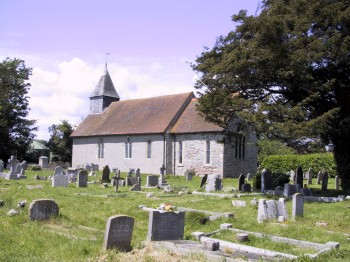
39. St George Eastergate
This 900 year old church was originally called 'gates' and in the Domesday Book it is recorded as being held by the Nunnery of St Martin de Seez in Normandy. Little of the Saxon church remains apart from a small window in the north wall of the chancel. Two plain glass lancet windows in the south wall date from the thirteenth century but much of the present interior dates from a Victorian restoration of 1883. The East Window has glass depicting the figure of Christ flanked by St George and St Michael, placed there as a memorial to Lord Kitchener the famous First World War Field Marshal who was drowned off the Orkney Islands whilst en route to Russia in 1916. Above the figure of St George is a desert scene with camels relating to Kitchener's exploits in Egypt and Sudan, whilst above St Michael, Christ is shown walking on the sea, a reminder of Kitchener's death by drowning. The elaborate inscription symptomatic of an Imperial Age reads "In grateful memory of Horatio Herbert, Earl Kitchener of Khartoum, His Majesty's Secretary of State for War from August 1914 to June 1916. His genius and indomitable energy and the implicit confidence reposed in him by his King and country enabled him to raise the vast armies that proved the salvation of the British Empire for which he laid down his life - coffined in a man of war he passed to the Great Beyond." There is one piece of medieval glass in the church. This is the Arundel Window in the south nave wall dating from 1360. This features the arms of the Fitzalan family quartered with those of the de Warennes of Lewes forebears of the present Norfolk family. The remaining glass is from the 1920's mostly relating to the First World War. The West Window commemorates the men of the parish killed in that war. A soldier and sailor kneel on either side of the figure of Christ crucified with the inscription "Greater Love hath no man than this" underneath. Two other windows commemorate individual soldiers. On the South side a window showing Christ holding a lamb and Christ knocking at the door (a copy of the famous Holman Hunt painting) was put there in memory of 2 Lt. Stanley Martin of the 15th Hampshire Regiment killed at Bailleul on 25 July 1916. Opposite in the North wall another window commemorates Lt. William Millar Warne R.G.A. killed at Neuve Chapelle in May 1915. A third window showing the figure of St Wilfrid is in memory of a former Rector of the parish. The floor of the nave contains a number of 18th century tombstones of the Boniface family, whilst the octagonal font probably dates from the late twelfth century. A number of modern features add to the beauty of the church such as a fine array of embroidered hassocks dating from the 1970's. Two illustrated rolls on the North wall list the rectors since 1345 and the church wardens from 1590. An interesting embroidered collage presented by the Mothers' Union in 1989 has 8 panels depicting the church and episodes from its history, all designed by Mrs Joan Packer. Also near the font on the south side is a fine wooden carving of St George. The walls and roof are of white plaster though some of the medieval roof timbers remain. The large organ on the north side dates from 1948. In the churchyard, notice the Judas tree near the path, planted in 1986 as part of the 900th anniversary of the Domesday Book. John Symonds |
|
page last updated 29 MAY 2000 |